


Sage and rosemary grow side by side on Ikaria's hillsides, and in Greek kitchens they often end up in the same pot of hot water. Both have been linked to memory since antiquity, and today scientists are testing that reputation in small human trials. This guide covers what sage and rosemary tea is, the real research on memory and the brain, what it does not show about Alzheimer's disease, how to brew the two together, and who should skip them.
Key takeaways
- The herbs: Greek sage (Salvia fruticosa), common sage (S. officinalis) and rosemary (Salvia rosmarinus) are close relatives in the mint family. All are caffeine-free.
- Memory research: small, short trials found single doses of sage extracts or oils improved memory or attention in healthy adults. Rosemary powder, drinks and aroma have shown small effects too.
- Alzheimer's: one small 4-month trial of a sage extract reported better cognitive scores. That is far from proof. No herb has been shown to treat or prevent Alzheimer's disease.
- How to brew: about ½ teaspoon of each dried herb per cup, covered, for 5–7 minutes. 1–2 cups a day is a sensible amount.
- Who should skip it: pregnant and breastfeeding women, people with epilepsy, and anyone allergic to mint-family plants. Sage contains thujone, so don't overdo it.
Featured in this article

Meet the herbs: Greek sage, common sage and rosemary
"Sage" covers several species, and the research doesn't always use the one in your cup. Rosemary, meanwhile, was moved into the sage genus in 2017, after DNA studies showed it belongs there.1 So a sage and rosemary tea (in France, tisane de sauge et romarin) is really a tea of two salvias.
| Herb | Where it grows | Notes |
|---|---|---|
| Greek sage, Salvia fruticosa | Greece, Crete, the eastern Mediterranean | The sage of Greek tea. Its oil is mostly 1,8-cineole, with little thujone.2 |
| Common sage, S. officinalis | Western Balkans, now worldwide | The kitchen sage. Used in most memory trials. Often higher in thujone. |
| Spanish sage, S. lavandulifolia | Spain, southern France | Studied as an essential oil for memory. |
| Rosemary, Salvia rosmarinus (formerly Rosmarinus officinalis) | All around the Mediterranean | Rich in rosmarinic acid, carnosic acid and 1,8-cineole. |
What they share is a family of aromatic compounds, especially 1,8-cineole, and the polyphenol rosmarinic acid. Both come up again and again in the memory research. Our Greek sage from Ikaria is true Salvia fruticosa, not common sage.

Sage and rosemary tea benefits
People reach for sage and rosemary tea for three reasons: digestion, a clear head, and simple enjoyment of a savoury, aromatic cup. Here's how the evidence stacks up:
- Traditional useThe European Medicines Agency recognises both sage leaf and rosemary leaf teas as traditional remedies for mild indigestion. Sage is also recognised for sore throats (as a gargle) and excessive sweating.
- Human studiesSmall, mostly single-dose trials of sage extracts, sage oil, rosemary powder and rosemary aroma, showing modest effects on memory, attention or mood. None tested a sage and rosemary tea.
- Lab and animalIn lab tests, both herbs inhibit the enzyme that breaks down acetylcholine, a memory messenger, and act as antioxidants. Rosemary's carnosic acid protects nerve cells in lab and animal models.
The digestive use is the best established. The EMA's monographs allow 1–2 g of sage or rosemary leaf per cup as an infusion for mild dyspepsia and bloating.3,4 These are "traditional use" listings, based on long safe use rather than modern trials. Our rosemary tea benefits guide covers rosemary on its own in more depth.
Sage for memory: the human studies
Sage has the more interesting human data. Most trials come from one research group in the UK and Australia, led by David Kennedy and Andrew Scholey. They are small, carefully controlled and short.
- Spanish sage oil in young adults (2003): in double-blind, placebo-controlled experiments with 20 and 24 healthy young volunteers, a single capsule of S. lavandulifolia essential oil improved word recall compared with placebo.5,6
- Dried common sage leaf (2006): 30 healthy adults took 300 mg or 600 mg of dried S. officinalis leaf or placebo on separate days. Both doses improved mood: the lower dose reduced anxiety, and the higher dose increased alertness, calmness and contentedness and improved performance on a demanding multitasking test.7
- Sage extract in older adults (2008): 20 volunteers over 65 (average age 73) received four doses of a sage extract and a placebo on separate days. The 333 mg dose improved memory and attention accuracy for several hours.8
The honest summary: sage can give a small, short-lived lift to memory and mood in a lab setting. These were extracts, oils and capsules of leaf, mostly common or Spanish sage, not cups of Greek sage tea. A 2017 review concluded that the findings are "tempered by the small sample sizes and short treatment duration".6 The US National Center for Complementary and Integrative Health reaches a similar verdict: promising but limited.9
Sage and rosemary are a lovely daily ritual with genuinely interesting brain research. They are not a treatment for memory loss.
Rosemary for memory and brain health
The rosemary studies are even smaller, but they test the herb in several forms:
- Rosemary powder in older adults (2012): 28 adults with an average age of 75 took four doses of dried rosemary powder or a placebo in a double-blind crossover trial. The lowest dose, 750 mg (about a culinary amount), improved speed of memory. The highest, 6,000 mg, impaired it.10 More is not better.
- Rosemary water (2018): 80 healthy adults drank 250 ml of a rosemary drink or plain water. The rosemary group showed small benefits on some cognitive tasks.11
- Rosemary aroma (2012): 20 volunteers sat in a room scented with rosemary essential oil before testing. The more 1,8-cineole in their blood, the faster and more accurate they were on mental arithmetic tasks.12 The same compound is released in the steam of rosemary tea, though the study didn't test tea.
- Rosemary vs lavender aroma (2003): in a controlled study of 144 healthy adults tested in a room scented with rosemary oil, lavender oil or no scent, rosemary significantly enhanced overall quality of memory, though it slowed speed of memory, and people in the rosemary room felt more alert than the other groups; lavender impaired working memory.13
In the lab, rosemary's carnosic acid switches on the body's own antioxidant defences in nerve cells and protected neurons in animal models.14 Carnosic acid is fat-soluble, though, so a water infusion carries relatively little of it.

Sage, rosemary and Alzheimer's: what the research doesn't show
Many people find this topic because someone they love has been diagnosed. Here is the evidence as plainly as we can put it.
The study most often quoted is a 2003 Iranian double-blind, randomised trial. Forty-two people aged 65–80 with mild to moderate Alzheimer's disease took 60 drops a day of a common sage (S. officinalis) extract or a placebo for four months. The sage group had significantly better outcomes on cognition than the placebo group, on both the ADAS-cog and the Clinical Dementia Rating scale, and side effects were no more common than with placebo.15 It's an interesting result, but it was a single small trial, using an alcohol extract rather than tea. It has not been confirmed by larger studies. A small open-label study of Spanish sage oil in 11 people with Alzheimer's also reported some benefits, without a placebo group.6
For rosemary, the Alzheimer's evidence is entirely from cells and animals. Claims that rosemary "prevents amyloid plaques" in people aren't supported by human studies.
So: there is no evidence that sage or rosemary tea treats, slows or prevents Alzheimer's disease, and it shouldn't replace any prescribed treatment. If you or a family member are noticing memory changes, please see a doctor. Some causes of memory problems are treatable, and early diagnosis opens up real options. The US National Institute on Aging has reliable information on Alzheimer's and dementia. A warm cup of tea can still be a comforting daily ritual for someone living with dementia. Check it with their doctor, since many take several medicines.
Shop the article

How to make sage and rosemary tea
Both herbs are strong and resinous, so a little goes a long way. Covering the cup keeps the aromatic oils, including 1,8-cineole, in the tea.
- Measure: ½ teaspoon dried Greek sage and ½ teaspoon dried rosemary (about 1–1.5 g in total) per 8 oz / 240 ml cup. With fresh herbs, use 3–4 sage leaves and a 2-inch rosemary sprig.
- Heat: bring water to a boil.
- Cover and steep for 5–7 minutes. Longer makes the cup more bitter, not more beneficial.
- Strain and finish: add a slice of lemon and a spoon of raw Ikaria heather honey if you like. Never give honey to babies under 12 months.
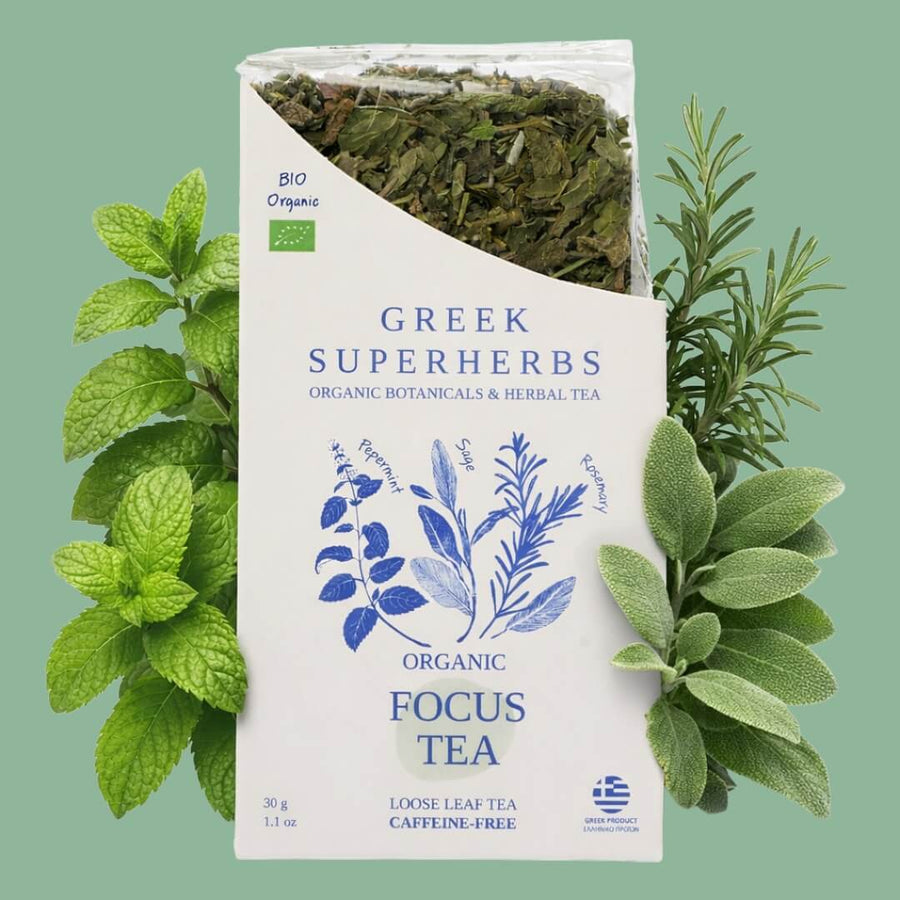
Prefer a ready-made blend? Focus Tea combines sage and rosemary with peppermint, which softens the savoury edge. Ikaria Blue Zone Tea pairs Greek sage and rosemary with dandelion root, the way it's brewed on the island. Read the story in our Ikarian herbal tea guide.
Best time to drink it
Mid-morning or early afternoon, when you want to feel clear-headed without caffeine, or after a meal for digestion. It's caffeine-free, but rosemary's aroma is bright, so some people prefer something gentler like chamomile at bedtime.
Safety: thujone, pregnancy and who should avoid it
At normal tea amounts, sage and rosemary are well tolerated by most adults. The main concern is thujone, a compound in sage oil that is toxic to the nervous system in large amounts. The EMA recommends keeping thujone intake below 6 mg a day and preferring low-thujone sages.3 Greek sage is relatively low in thujone,2 and a normal cup contains very little, but it's another reason not to brew sage very strong or drink it in large amounts for months.
Pregnancy and breastfeeding: avoid medicinal amounts of both herbs. The EMA does not recommend sage or rosemary teas in pregnancy or breastfeeding, and the NIH notes sage may be unsafe in pregnancy because of thujone.3,4,9 Culinary use in food is fine.
Epilepsy and seizure disorders: avoid sage tea and sage or rosemary essential oils. The EMA warns that excessive sage intake can cause convulsions.3
Children: the EMA doesn't recommend sage as a remedy for under-18s, or rosemary for under-12s, because of limited data.3,4
Gallbladder and liver: if you have gallstones, bile-duct problems or liver disease, ask your doctor before drinking rosemary tea regularly.4
Allergy: skip it if you react to mint-family plants (mint, oregano, thyme, lavender).
Medications: if you take regular prescription medicines, including for epilepsy, diabetes, blood pressure or dementia, check with your doctor or pharmacist first.
How much: 1–2 cups a day, with breaks. Never drink sage or rosemary essential oil.

Sage and rosemary tea FAQ
What are the benefits of sage and rosemary tea?
Both herbs are recognised in Europe as traditional remedies for mild indigestion. Small human studies suggest sage and rosemary in various forms can briefly improve memory, attention or mood, and both are rich in antioxidant rosmarinic acid. The tea itself hasn't been studied, so think of it as a caffeine-free ritual that may support focus, not a treatment.
Is rosemary tea good for memory?
Possibly, in a modest way. In a small trial of older adults, a low dose of rosemary powder (750 mg) improved speed of memory, while a very high dose impaired it. A rosemary drink and rosemary aroma have also shown small effects. No trial has tested rosemary tea for memory over the long term.
Does sage help with memory?
Several small, short trials found single doses of sage extract, dried leaf or sage oil improved memory or attention in healthy young and older adults. The effects were modest and lasted hours, and the studies mostly used common or Spanish sage.
Can sage and rosemary tea help with Alzheimer's?
There is no evidence that it treats or prevents Alzheimer's disease. One small 2003 trial of a sage extract in people with mild to moderate Alzheimer's reported better cognitive scores, but it hasn't been confirmed. If you're worried about memory, please see a doctor.
Can you drink sage and rosemary together?
Yes. They're a traditional Greek pairing and taste good together. Use about ½ teaspoon of each dried herb per cup and steep covered for 5–7 minutes. Stick to 1–2 cups a day.
How much sage and rosemary tea can I drink a day?
1–2 cups a day of a normal-strength brew is sensible for healthy adults, with occasional breaks. Because sage contains thujone, avoid very strong brews or large amounts over long periods.
Who should not drink sage and rosemary tea?
Pregnant or breastfeeding women, people with epilepsy, children as a remedy, and anyone allergic to mint-family plants. People with gallbladder or liver disease or who take regular medication should check with their doctor.
Sage and rosemary have been Greek kitchen companions for thousands of years, and science is starting to take their reputation for memory seriously. The evidence is early, small and mostly about extracts, but as a warm, caffeine-free cup that tastes of the Ikarian hillside, sage and rosemary tea earns its place in the day.
Shop the article


Keep reading: Rosemary tea benefits · Greek mountain tea and focus · Cretan herbal teas
Sources
- Drew BT, González-Gallegos JG, Xiang CL, et al. Salvia united: the greatest good for the greatest number. Taxon. 2017;66(1):133–145. doi:10.12705/661.7
- European Medicines Agency, HMPC. Assessment report on Salvia fruticosa Mill., folium. 2016.
- European Medicines Agency, HMPC. European Union herbal monograph on Salvia officinalis L., folium (Rev. 1). Adopted 20 September 2016.
- European Medicines Agency, HMPC. European Union herbal monograph on Rosmarinus officinalis L., folium (Rev. 1). 2024.
- Tildesley NTJ, Kennedy DO, Perry EK, et al. Salvia lavandulaefolia (Spanish sage) enhances memory in healthy young volunteers. Pharmacol Biochem Behav. 2003;75(3):669–674.
- Lopresti AL. Salvia (sage): a review of its potential cognitive-enhancing and protective effects. Drugs R D. 2017;17(1):53–64.
- Kennedy DO, Pace S, Haskell C, et al. Effects of cholinesterase inhibiting sage (Salvia officinalis) on mood, anxiety and performance on a psychological stressor battery. Neuropsychopharmacology. 2006;31(4):845–852.
- Scholey AB, Tildesley NTJ, et al. An extract of Salvia (sage) with anticholinesterase properties improves memory and attention in healthy older volunteers. Psychopharmacology. 2008;198(1):127–139.
- National Center for Complementary and Integrative Health (NIH). Sage. Updated April 2025.
- Pengelly A, Snow J, Mills SY, et al. Short-term study on the effects of rosemary on cognitive function in an elderly population. J Med Food. 2012;15(1):10–17.
- Moss M, Smith E, Milner M, McCready J. Acute ingestion of rosemary water: evidence of cognitive and cerebrovascular effects in healthy adults. J Psychopharmacol. 2018;32(12):1319–1329.
- Moss M, Oliver L. Plasma 1,8-cineole correlates with cognitive performance following exposure to rosemary essential oil aroma. Ther Adv Psychopharmacol. 2012;2(3):103–113.
- Moss M, Cook J, Wesnes K, Duckett P. Aromas of rosemary and lavender essential oils differentially affect cognition and mood in healthy adults. Int J Neurosci. 2003;113(1):15–38.
- Satoh T, Kosaka K, Itoh K, et al. Carnosic acid, a catechol-type electrophilic compound, protects neurons both in vitro and in vivo through activation of the Keap1/Nrf2 pathway via S-alkylation of targeted cysteines on Keap1. J Neurochem. 2008;104(4):1116–1131.
- Akhondzadeh S, Noroozian M, et al. Salvia officinalis extract in the treatment of patients with mild to moderate Alzheimer's disease: a double blind, randomized and placebo-controlled trial. J Clin Pharm Ther. 2003;28(1):53–59.
This article is for general information and is not medical advice. These statements have not been evaluated by the FDA. Our products are not intended to diagnose, treat, cure or prevent any disease. If you are pregnant, nursing, taking medication or have a medical condition, talk to your doctor first.


