

Every Greek kitchen has a bundle of it. Shepherds on Mount Olympus brew it at dawn, grandmothers pour it at the first sign of a cold, and after a heavy dinner someone always puts the kettle on for it. Greek mountain tea, tsai tou vounou, is the country's everyday herbal tea. Scientists have only started studying it closely in the last fifteen years. Here is what it is, what the research does and doesn't show, how much to use per cup, and who should skip it.
Key takeaways
- What it is: the dried flowering stems of Sideritis, a wild plant that grows above 1,000 m in the Greek mountains. It is naturally caffeine-free.
- Officially recognised: the European Medicines Agency lists mountain tea as a traditional herbal remedy to ease a cough that comes with a cold and to relieve mild digestive discomfort.
- Emerging science: in a 28-day trial in adults aged 50–70, a concentrated extract reduced anxiety and improved one measure of attention. Lab and animal studies point to antioxidant and anti-inflammatory effects.
- How much: about 2 g (a heaped teaspoon of crumbled stems) per cup, 2–3 cups a day.
- Who should skip it: people allergic to mint-family plants. The EMA also advises against it during pregnancy and breastfeeding because safety hasn't been studied.
Featured in this article


What is Greek mountain tea?
Greek mountain tea isn't tea in the Camellia sinensis sense. It is an herbal infusion made from Sideritis, a genus in the mint family (Lamiaceae) with woolly, silver-green leaves and small yellow flowers. The name comes from sideros, Greek for iron, and English speakers sometimes call it ironwort. In Greece you'll hear tsai tou vounou (mountain tea), shepherd's tea, or malotira on Crete.
Several species are sold as mountain tea. Each grows wild on a different range:
| Species | Where it grows | Also known as |
|---|---|---|
| Sideritis scardica | Mount Olympus and the northern Balkans | Olympus tea, Pirin tea, Mursalski tea |
| Sideritis raeseri | Central Greece and Epirus | Parnassus mountain tea |
| Sideritis syriaca | Crete | Malotira |
| Sideritis clandestina | Peloponnese (Taygetos, Parnon) | Taygetos tea |
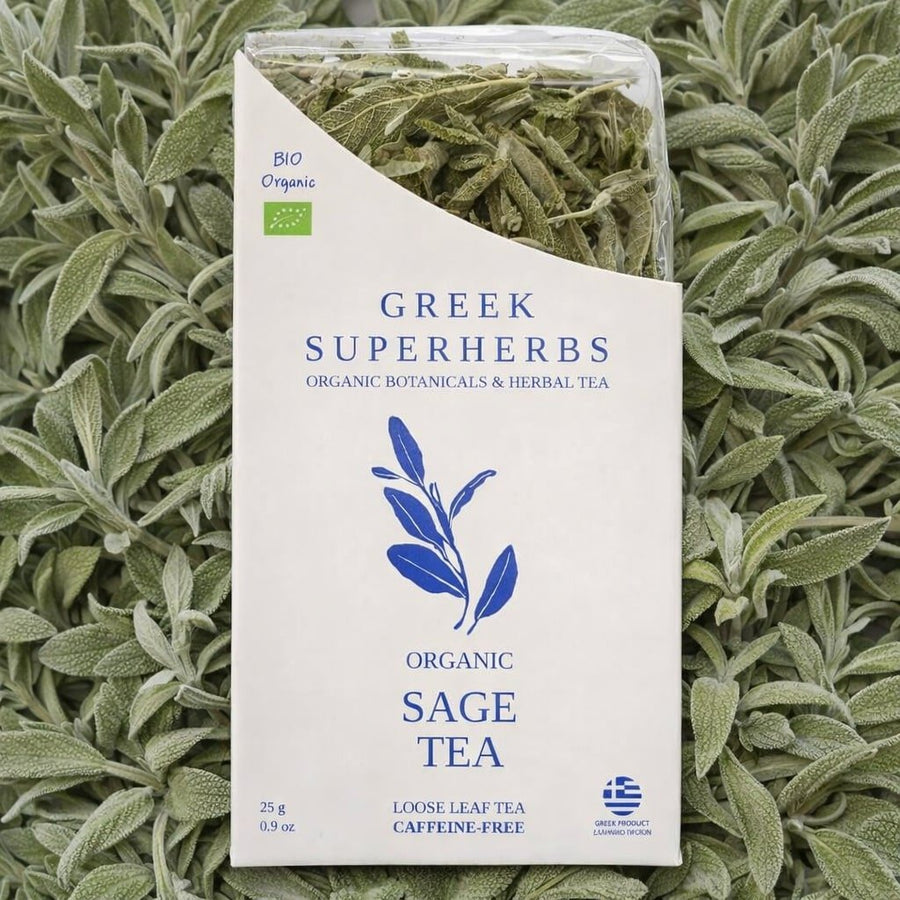
All four are covered by the same European herbal monograph and brew into a similar golden, gently sweet cup. Its flavour is floral and a little earthy, with a hint of citrus and chamomile. Ours is Sideritis scardica from Mount Olympus, cut by hand above 1,000 m and air-dried in bundles.

Greek mountain tea benefits: what the research shows
Most of what people say about mountain tea online mixes tradition, lab studies and marketing. Here is what each type of evidence actually supports:
- Official recognitionThe European Medicines Agency accepts long-standing use for coughs with colds and mild digestive upset (2016 monograph).
- Human trialOne randomised, placebo-controlled trial of 155 adults aged 50–70 who took an extract for 28 days found less anxiety and fewer attention errors.
- Lab and animalStrong antioxidant and anti-inflammatory activity, effects on mood-related brain chemistry, and memory benefits in mice.
1. A traditional remedy for coughs and colds
This is mountain tea's oldest use, and the one with official backing. The EMA's Committee on Herbal Medicinal Products reviewed decades of use across Greece and the Balkans. It concluded that Sideritis infusions can be used to relieve a cough associated with a cold. That is a "traditional use" listing, meaning the long safe record is accepted but it hasn't been proven in modern trials.1
The Greek way is a hot cup with a spoon of raw honey and a squeeze of lemon, sipped slowly while the steam loosens things up.
2. Gentle help for digestion
The same monograph lists mountain tea for mild gastrointestinal discomfort, the bloated, heavy feeling after a big meal.1 Its aromatic oils and flavonoids are thought to relax the gut a little. It's why the kettle goes on after Sunday lunch in Greek homes. If symptoms last more than two weeks, see a doctor rather than relying on tea.
3. Focus, mood and the ageing brain
This is the most exciting area, and the one where it's easiest to overstate things.
- In people: a 2018 randomised, double-blind trial gave 155 healthy adults aged 50–70 a Sideritis scardica extract (475 mg or 950 mg a day), ginkgo, or a placebo for 28 days. At the higher dose, people made fewer errors on a demanding attention test and reported lower anxiety. On the first day, both doses also increased blood oxygen in the front of the brain during mental tasks.2
- In the lab: mountain tea extracts slowed the reuptake of serotonin, noradrenaline and dopamine in cell studies. That's the same general mechanism as some mood medicines, though much milder.3 In mice bred to develop Alzheimer's-like changes, Sideritis extracts improved memory and reduced amyloid plaques.4
The honest summary: the early signs are promising for focus and calm, but the trial used concentrated extracts, not cups of tea, and mouse results often don't carry over to people. It's a reason to enjoy mountain tea, not a treatment for memory loss.
Mountain tea won't replace anything your doctor prescribes. It is a caffeine-free daily ritual with a surprisingly interesting research record.
4. Rich in antioxidants and anti-inflammatory compounds
Sideritis is full of polyphenols, especially phenylethanoid glycosides such as verbascoside, along with flavonoids like apigenin and luteolin. In lab tests these compounds neutralise free radicals and dampen inflammatory signals.5 That's the basis for most of the "superfood" claims. It's real chemistry, but the antioxidant effect of a cup of tea in the body is modest and hard to measure.
Does mountain tea help with sleep or weight loss?
Sleep: it has no caffeine, and the extract trial found lower anxiety. That's why many Greeks drink it in the evening. No study has tested it directly for sleep, though. If sleep is your main goal, chamomile has more research behind it. See our guide to the best herbs for sleep.
Weight loss: there is no good evidence that mountain tea causes weight loss. Swapping a sugary drink or a late coffee for an unsweetened cup is a small, sensible change. Any product promising more is overselling it.

How to make Greek mountain tea
Because the leaves are whole and woolly, mountain tea needs hotter water and a longer steep than green tea. Here's the method we use:
- Measure: 1 heaped teaspoon of crumbled stems (about 2 g) per 8 oz / 240 ml cup, or 3–4 finger-length pieces of stem.
- Heat: bring water just off the boil (about 205–212°F / 96–100°C).
- Cover and steep for 5–7 minutes. Covering keeps the aromatic oils in the cup. For a stronger, more traditional brew, simmer the stems in the pot for 3 minutes.
- Strain and sip: add honey, lemon or a cinnamon stick if you like. Then steep the same herbs a second time. Whole stems give a second cup easily.
| Style | How much | How long |
|---|---|---|
| Everyday cup | ~2 g per 8 oz | 5–7 min, covered |
| Traditional (for a cold) | 2–4 g per 5–7 oz | Simmer 3 min, rest 5 min |
| Iced / cold brew | 4–6 tsp per quart | Overnight in the fridge |
| Upper limit | No more than 12 g a day (about 5–6 cups), per the EMA | |
In summer, cold brew is the best way to drink it. There's a step-by-step in our cold brew herbal tea guide. Greeks also mix mountain tea with sage, oregano or chamomile. That's the basis of the Ikaria Blue Zone tea ritual.
Shop the article



Greek mountain tea side effects and safety
Mountain tea has been drunk daily for centuries, and the EMA monograph lists no known side effects at normal amounts.1 A few groups should still be careful:
Allergy: avoid it if you react to plants in the mint family (mint, sage, oregano, thyme, rosemary). This is the only formal contraindication.
Pregnancy and breastfeeding: many Greek families drink it anyway. But its safety hasn't been studied, so the EMA does not recommend it in pregnancy or while breastfeeding. Talk to your doctor or midwife first.
Children: the EMA monograph doesn't recommend it as a remedy for under-18s because of limited data. The occasional mild, cooled cup as a drink is a different matter from using it as treatment, but ask your paediatrician.
Medications and liver: no liver toxicity or drug interactions have been reported. If you take several prescription drugs or have liver or kidney disease, check with your doctor before drinking it every day.
How much: stay within 2–3 cups a day, with no more than 12 g of dried herb in total.
How to choose good Greek mountain tea
Quality varies a lot, and most of the benefit sits in the flower heads. What to look for:
- Whole stems with intact yellow-green flower heads, not crushed powder or tea-bag dust, which lose their aromatic oils quickly.
- A named species and region, for example Sideritis scardica, Mount Olympus. Vague "Greek herbs" labels are a warning sign.
- Organic certification from an EU body. Ours is certified by Eurocert (GR-BIO-15).
- A fresh, sweet, hay-like smell when you open the bag. Old or badly stored tea smells flat and dusty.
- Stored airtight, away from light. Whole stems keep their flavour for about two years.

Greek mountain tea FAQ
What is Greek mountain tea good for?
Traditionally it's used for coughs with colds and for mild digestive discomfort. The European Medicines Agency recognises both uses. Early research also suggests it may help with calm and focus, and it's rich in antioxidants. It's naturally caffeine-free, so it works any time of day.
Does Greek mountain tea have side effects?
No side effects are known at normal amounts. Avoid it if you're allergic to mint-family plants. Ask your doctor first if you're pregnant, breastfeeding or taking several medications.
Can I drink Greek mountain tea while pregnant?
Its safety in pregnancy and breastfeeding hasn't been studied, so the EMA does not recommend it. Please check with your doctor or midwife before drinking it.
Can I drink mountain tea every day?
Yes. Most Greeks do. 2–3 cups a day is a typical amount, with no more than 12 g of dried herb in total.
How much Greek mountain tea per cup?
About 2 g, a heaped teaspoon of crumbled stems, per 8 oz / 240 ml of water just off the boil. Steep covered for 5–7 minutes.
Does Greek mountain tea contain caffeine?
No. Sideritis is naturally caffeine-free.
Is Greek mountain tea the same as sideritis or ironwort?
Yes. Greek mountain tea, tsai tou vounou, ironwort, shepherd's tea and malotira all refer to species of Sideritis.
Mountain tea is Greece's everyday cup: caffeine-free, easy to brew, and backed by a long tradition and a growing body of research. Start with a cup after dinner and see how it fits your routine.
Shop the article

Keep reading: Cretan herbal teas: dittany, sage and malotira · Sage, rosemary and memory · Oregano tea
Sources
- European Medicines Agency, HMPC. European Union herbal monograph on Sideritis scardica, S. clandestina, S. raeseri, S. syriaca, herba. Adopted 2 February 2016.
- Wightman EL, et al. The acute and chronic cognitive and cerebral blood flow effects of a Sideritis scardica (Greek mountain tea) extract. Nutrients. 2018;10(8):955.
- Knörle R. Extracts of Sideritis scardica as triple monoamine reuptake inhibitors. J Neural Transm. 2012;119(12):1477–1482.
- Hofrichter J, et al. Sideritis spp. extracts enhance memory and learning in Alzheimer's β-amyloidosis mouse models and aged C57Bl/6 mice. J Alzheimers Dis. 2016;53(3):967–980.
- Todorova M, Trendafilova A. Sideritis scardica Griseb., an endemic species of Balkan peninsula: traditional uses, cultivation, chemical composition, biological activity. J Ethnopharmacol. 2014;152(2):256–265.
This article is for general information and is not medical advice. These statements have not been evaluated by the FDA. Our products are not intended to diagnose, treat, cure or prevent any disease. If you are pregnant, nursing, taking medication or have a medical condition, talk to your doctor first.


