

On Ikaria, the kettle is never far away. Islanders pick sage, oregano, rosemary and mountain tea from the hillsides, dry them in bundles and brew them strong, often with a spoon of local honey. Ikaria tea has become a shorthand for the island's famous longevity. Here is what Ikarians actually drink, what the IKARIA study did and didn't find, what's in our Ikaria Blue Zone Tea, a simple Ikaria tea recipe you can make at home, and who should be careful.
Key takeaways
- What it is: "Ikaria tea" isn't one recipe. It's the family of wild-herb infusions islanders drink every day: Greek sage, mountain tea, oregano, rosemary, dandelion, chamomile and others.
- The research: the IKARIA study linked long life on the island to daily activity, diet, naps, not smoking and social life. Herbal tea is part of that way of life, but no study has shown it causes longevity.
- Our blend: Ikaria Blue Zone Tea is dandelion root, Greek sage (Salvia fruticosa) and rosemary, wild-harvested on Ikaria. It's caffeine-free.
- How to brew: 1 teaspoon per 12 oz of water, simmered gently for 5–7 minutes. 2–3 cups a day.
- Who should check first: people who are pregnant or breastfeeding, take diuretics or lithium, have gallbladder disease, or are allergic to daisy-family or mint-family plants.
Featured in this article


What is Ikaria tea?
Ikaria is a mountainous island in the eastern Aegean, and one of the world's five original Blue Zones: places with an unusually high share of people living into their 90s. Its wild slopes are covered in aromatic herbs, and brewing them is as ordinary as boiling water. Ikaria tea (also called Ikarian or Icarian tea) simply means these island herbal infusions.
There's no single official recipe. Each household has its own mix, depending on what grows nearby and what the tea is for: sage for a sore throat, mountain tea for a cold, oregano or chamomile after a heavy meal. Our Ikaria Blue Zone Tea is one version of this tradition: dandelion root, Greek sage and rosemary, wild-harvested on the island.

What Ikarians actually drink
Here are the herbs you're most likely to find drying in an Ikarian kitchen:
| Herb | Greek name | How it's used |
|---|---|---|
| Greek sage (Salvia fruticosa) | faskomilo | The everyday island tea; for sore throats and after meals |
| Mountain tea (Sideritis) | tsai tou vounou | Colds, coughs and evening cups |
| Oregano and wild marjoram (Origanum) | rigani | Digestion; also the island's main cooking herb |
| Rosemary (Salvia rosmarinus) | dentrolivano | Added to blends for flavor and digestion |
| Dandelion (Taraxacum) | taraxako | Leaves eaten as wild greens; root brewed as tea |
| Chamomile (Matricaria) | chamomili | Upset stomach and bedtime |
Ikarian mountain tea is a common search, and mountain tea is certainly drunk on Ikaria. The best-known species grow on the high mountains of mainland Greece and Crete. For species, benefits and brewing, see our full guide to Greek mountain tea.
Do Greeks make dandelion tea? Mostly, Greeks eat dandelion and other wild greens boiled as horta, dressed with olive oil and lemon. Brewing the root as a tea is less common, but it's part of the island's herbal tradition and gives a pleasant roasted, earthy note to a blend.
Journalist Dan Buettner, who popularized the Blue Zones, reported that Ikarians drink teas of rosemary, wild sage, oregano, marjoram, mint and dandelion, and suggested their mild diuretic effect might help keep blood pressure down. That's an interesting idea, but it hasn't been tested in a study.

Ikaria tea and longevity: what the research shows
The main science on the island comes from the IKARIA study, run by cardiologists from the University of Athens. In 2009 they enrolled 1,420 residents aged 30 and over, including 187 people over 80. Most of the oldest participants reported daily physical activity, healthy eating, not smoking, frequent socializing, midday naps and very low rates of depression. The authors concluded that these changeable habits "might depict the secrets" of long life on Ikaria.1
The same research group looked at one drink in detail: coffee. In 142 islanders aged over 65, those who mainly drank traditional boiled Greek coffee had better endothelial function (how well blood vessels relax) than those who drank other types.2 That was a snapshot comparison. It shows an association, not that coffee caused the difference.
A 2021 survey of 71 Ikarians aged 90 and over found very high levels of family support, social contact and physical activity. The authors called the Mediterranean diet results "less convincing."3
What about herbal tea? It's part of daily life on the island, but none of the IKARIA papers we reviewed measured herbal tea on its own or linked it to longer life. So the honest answer is this: Ikaria tea is a genuine island habit and a pleasant, caffeine-free drink. It isn't a proven longevity treatment.
Ikarians don't drink herbal tea to live longer. They drink it because it grows outside the door, and they drink it together.
The herbs in our Ikaria tea: what the evidence says
Each of the three herbs in our blend has its own research record. Here's how it breaks down:
- Traditional useThe European Medicines Agency recognizes sage, rosemary and dandelion as traditional herbal remedies, mainly for mild digestive complaints.
- Human studiesSmall pilot studies only: a sage-tea study in six women and a one-day dandelion diuretic study in 17 women.
- Lab and animalAll three are rich in polyphenols, such as rosmarinic acid in sage and rosemary, with antioxidant and anti-inflammatory activity in the lab.
Greek sage (Salvia fruticosa)
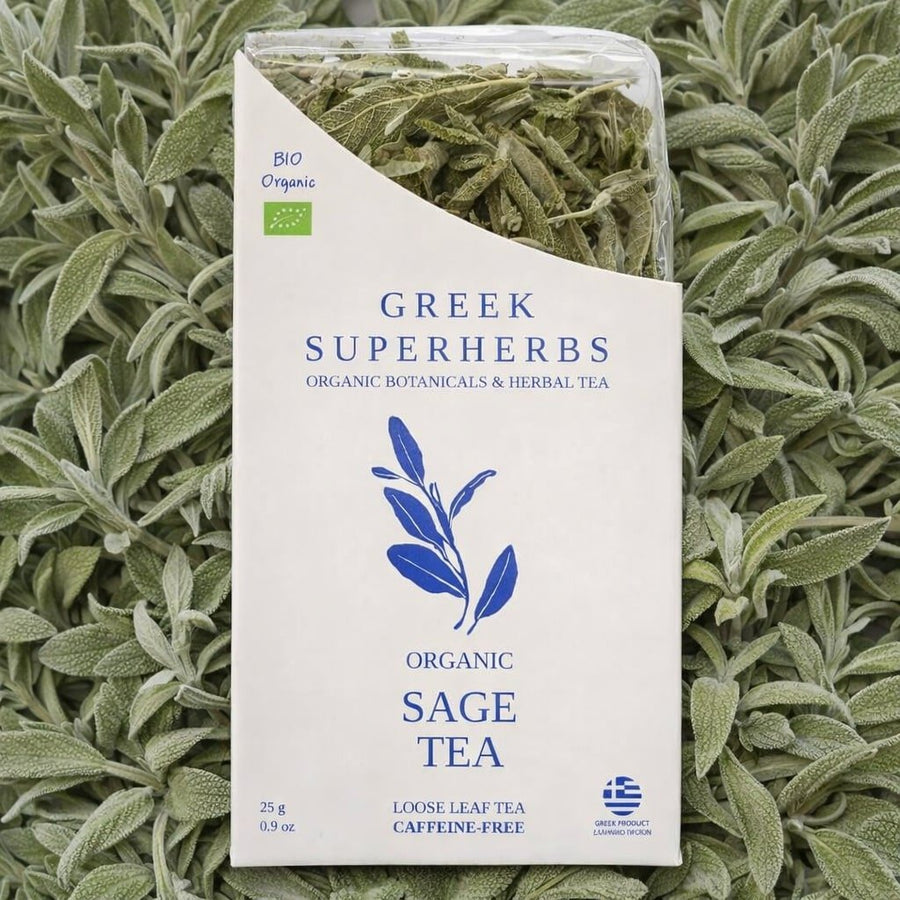
Greek sage is the heart of Ikarian tea. It's softer and more floral than common garden sage (Salvia officinalis). The EMA lists sage leaf as a traditional remedy for mild indigestion, such as heartburn and bloating, and for sore mouth and throat.4 In a small pilot study, six women drank 300 ml of common sage tea twice a day for four weeks. Their total and LDL cholesterol fell, and antioxidant enzymes in their blood rose, with no liver side effects.5 Six people and no control group is far too few to draw conclusions, but it's a reason for more research. Sage and rosemary are also studied for memory; see our article on sage and rosemary tea.
Rosemary
Rosemary adds a pine-like, savory lift to the blend. The EMA recognizes rosemary leaf tea as a traditional remedy for indigestion and mild gut cramps, at 1–2 g per cup, 2–3 times a day.6 Its antioxidant compounds are well studied in the lab. Human trials of rosemary tea itself are still few.
Dandelion root
Dandelion root gives the blend its earthy, slightly bitter base. The EMA lists it as a traditional remedy for mild digestive complaints, temporary loss of appetite, and to increase urine flow as a support in minor urinary complaints.7 A single-day study in 17 women found that a dandelion leaf extract increased how often they urinated.8 The U.S. National Center for Complementary and Integrative Health notes there's no compelling evidence dandelion helps any specific health condition.9
Shop the article



DIY Ikaria tea recipe
You can make a simple Ikarian-style blend with herbs you may already have. This makes about 20 cups.
- 3 tablespoons Greek sage (Salvia fruticosa), crumbled
- 2 tablespoons mountain tea (Sideritis), broken into short pieces
- 1 tablespoon rosemary leaves
- 1 tablespoon dried dandelion root, cut
- 1 teaspoon dried Ikaria oregano (optional; it's strong)
Mix well and store in an airtight jar away from light. Want a lighter, more floral cup? Swap the dandelion for chamomile. For a ready-made version, our Ikaria Blue Zone Tea is dandelion root, Greek sage and rosemary from the island.
Traditional additions include a spoon of raw Ikaria honey, a squeeze of lemon, or a strip of orange peel. Our guide to Ikaria honey explains the island's three types.

How to brew Ikaria tea
Woody herbs like rosemary and dandelion root need more heat than a quick steep. The island way is to simmer them briefly.
- Measure: 1 teaspoon (a generous pinch) of herbs per 12 oz / 350 ml of water.
- Boil, then lower: bring the water to a boil, add the herbs and turn the heat to low.
- Simmer gently for 5–7 minutes with the lid on, to keep the aromatic oils in.
- Strain and rest: let it cool for a minute before adding honey or lemon.
| Style | How much | How long |
|---|---|---|
| Hot, everyday | 1 tsp per 12 oz | Simmer 5–7 min, covered |
| Steeped (no stove) | 1 heaped tsp per 8 oz | Boiling water, covered, 8–10 min |
| Iced / cold brew | 4–6 tsp per quart (1 liter) | Overnight in the fridge |
| How often | 2–3 cups a day is a typical, sensible amount | |
Cold brew is the summer version on the island. See our step-by-step cold brew herbal tea guide.
Ikaria tea safety and side effects
In the amounts used for tea, these herbs have a long record of safe use. A few groups should take care:
Allergy: avoid dandelion if you're allergic to daisy-family plants (ragweed, chamomile, marigold). Avoid sage and rosemary if you react to mint-family herbs.
Pregnancy and breastfeeding: the EMA does not recommend medicinal use of sage, rosemary or dandelion during pregnancy or breastfeeding, because safety hasn't been established.4,6,7 Ask your doctor or midwife first.
Medications: dandelion may interact with water pills (diuretics), diabetes drugs and blood thinners.9 Because it increases urine flow, check with your doctor if you take lithium, since changes in fluid balance can affect lithium levels.
Gallbladder and liver: the EMA advises against dandelion if you have a blocked bile duct, gallstones, other biliary disease or liver disease. It also advises against it if you've been told to limit fluids.7
Sage and thujone: common sage contains thujone, which is toxic in large amounts. The EMA recommends keeping daily thujone intake below 6 mg and preferring low-thujone plants.4 Greek sage usually contains very little thujone.10 Stick to normal cup amounts, and never drink sage essential oil.
Children: the EMA monographs don't recommend these herbs as remedies for children under 12 (under 18 for sage). An occasional weak cup as a drink is different from medicinal use, but ask your pediatrician.
Pennyroyal: some traditional Ikarian mixes include fliskouni (pennyroyal). Leave it out if you're pregnant; its concentrated oil is toxic. Our blend doesn't contain it.
How much: 2–3 cups a day. If a digestive complaint lasts longer than two weeks, see a doctor.
Ikaria tea FAQ
What is Ikaria tea?
Ikaria tea is the herbal tea people drink on the Greek Blue Zone island of Ikaria. It's usually brewed from wild herbs such as Greek sage, mountain tea, oregano, rosemary and dandelion. Our Ikaria Blue Zone Tea blends dandelion root, Greek sage and rosemary from the island.
What is in Ikarian tea?
There's no single recipe. Common Ikarian herbs are Greek sage, mountain tea (Sideritis), oregano and wild marjoram, rosemary, dandelion and chamomile. Honey and lemon are the usual additions.
What is Blue Zone tea?
"Blue Zone tea" usually means the herbal teas drunk in Ikaria, Greece, one of the five Blue Zones where people often live into their 90s. They're caffeine-free infusions of local wild herbs rather than black or green tea.
Is Ikaria tea good for longevity?
Herbal tea is part of daily life on Ikaria, but no study shows it makes people live longer. The IKARIA study linked longevity to physical activity, diet, not smoking, naps and strong social ties. Enjoy it as a caffeine-free daily habit, not a longevity treatment.
How do you make Ikaria tea?
Simmer 1 teaspoon of herbs in 12 oz of water on low heat for 5–7 minutes with the lid on, then strain. For a DIY blend, mix Greek sage, mountain tea, rosemary and dandelion root, with a little oregano if you like.
What is Ikarian mountain tea?
It's Sideritis, the Greek mountain tea, as drunk on Ikaria. It's often mixed with sage or chamomile. See our Greek mountain tea guide for species, benefits and brewing.
Do Greeks make dandelion tea?
Greeks more often eat dandelion leaves as boiled wild greens (horta) with olive oil and lemon. Dandelion root tea is less common but is part of the herbal tradition and adds an earthy note to blends.
Does Ikaria tea have caffeine?
No. Sage, rosemary and dandelion root are naturally caffeine-free, so you can drink it in the evening.
Ikaria tea is less a secret formula than a habit: wild herbs, simmered simply, shared often. Make a pot, add a spoon of island honey, and take the time to drink it slowly.
Shop the article


Keep reading: Greek mountain tea benefits · Ikaria honey guide · Oregano tea
Sources
- Panagiotakos DB, Chrysohoou C, Siasos G, et al. Sociodemographic and lifestyle statistics of oldest old people (>80 years) living in Ikaria island: the Ikaria study. Cardiology Research and Practice. 2011;2011:679187.
- Siasos G, Oikonomou E, Chrysohoou C, et al. Consumption of a boiled Greek type of coffee is associated with improved endothelial function: the Ikaria study. Vascular Medicine. 2013;18(2):55–62.
- Legrand R, Nuemi G, Poulain M, Manckoundia P. Description of lifestyle, including social life, diet and physical activity, of people ≥90 years living in Ikaria, a longevity Blue Zone. Int J Environ Res Public Health. 2021;18(12):6602.
- European Medicines Agency, HMPC. European Union herbal monograph on Salvia officinalis L., folium. Adopted 20 September 2016.
- Sá CM, et al. Sage tea drinking improves lipid profile and antioxidant defences in humans. Int J Mol Sci. 2009;10(9):3937–3950.
- European Medicines Agency, HMPC. European Union herbal monograph on Rosmarinus officinalis L., folium. Revision 1, adopted 29 May 2024.
- European Medicines Agency, HMPC. European Union herbal monograph on Taraxacum officinale F.H. Wigg., radix. Adopted 24 November 2021.
- Clare BA, Conroy RS, Spelman K. The diuretic effect in human subjects of an extract of Taraxacum officinale folium over a single day. J Altern Complement Med. 2009;15(8):929–934.
- National Center for Complementary and Integrative Health. Dandelion.
- Karalija E, Dahija S, Tarkowski P, Ćavar Zeljković S. Influence of climate-related environmental stresses on economically important essential oils of Mediterranean Salvia sp. Frontiers in Plant Science. 2022;13:864807.
This article is for general information and is not medical advice. These statements have not been evaluated by the FDA. Our products are not intended to diagnose, treat, cure or prevent any disease. If you are pregnant, nursing, taking medication or have a medical condition, talk to your doctor first.


